Apple Suitens Its Apps
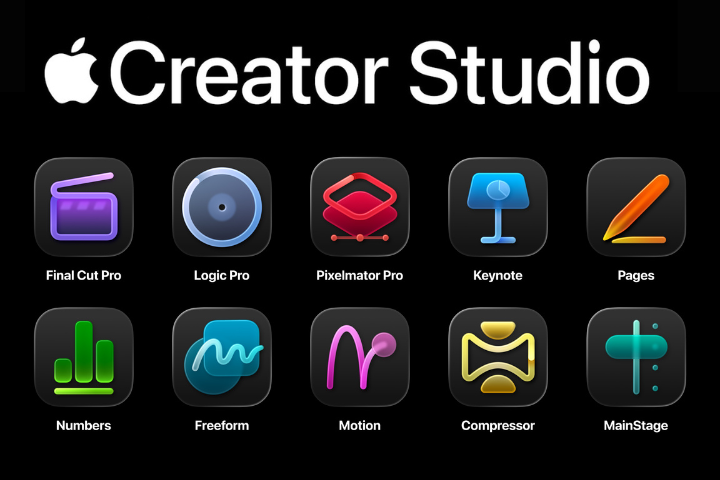
Apple is bundling its creative and productivity apps into Creator Studio. This is partly about generating recurring subscription revenue but mostly about protecting (or enhancing) its platforms from a new generation of competition.
Context
Apple could be content to let others build software on its platform, but it has long considered creative content to be a core part of its brand and has built (or bought and rebuilt) its own creation and productivity apps. This has also protected Apple's hardware sales by ensuring high-quality core applications that only run on its own operating systems. Microsoft abandoning Office for Mac was the big concern in the late 1990's, but cloud-based apps from Google and Canva are a bigger concern today.
Apple believes that there are more creators today than ever before, creators are now multi-disciplinary, and AI tools are expected. That’s accurate. There are still specialists in video editing, photography, and music creation, but regular consumers and entrepreneurs are expected to create video with music backing tracks, thumbnail images, pitch decks, text, and more. Standards are higher across the board, and output expectations are higher.
Borrowing a move from Microsoft and Lotus in the early 1990's, Apple is suite-ifying most of its creative and productivity apps into Creator Studio (see Apple’s press release). Apple is adding AI-driven features throughout the apps, including new Synth Players and ChordID in Logic Pro, the ability to search by transcript and mark beats on a music track in Final Cut Pro, and much more. Apple's new Content Hub has "original, highly curated" objects, backgrounds, icons, illustrations, photography, themes, and more for use across the suite.
Pricing
Given that Apple is including its genuinely professional-class video, music, and recently-acquired PixelMator Pro photo editing/drawing software, pricing for the bundle is aggressive: $13/month or $129 annual subscription, or $3/month or $30 a year for students. Up to six family members can share Creator Studio apps with Family Sharing. Importantly, Apple is moving its productivity apps -- Pages, Numbers, and Keynote -- to a two-tiered pricing model. The baseline apps remain free with purchase of iPhones, Macs, and iPads, while the new Content Hub and AI features will require the subscription. Apple is using different AI models for features as needed, and continues to rely on OpenAI for some of them, despite yesterday's Gemini news.
Strengthening the Apple Ecosystem - INcluding iPaD
All these apps will also have iPad versions, including PixelMator for iPad with a touch-first user interface, layers sidebar, selection tools, advanced bitmaps and vector maps, and warp and twist tools. The iPad app will also offer comprehensive Pencil support with hover, squeeze, pressure, etc. Providing purpose-built iPad apps strengthens Apple's ecosystem overall, not just relative to Android; Continuity features enable using the iPad as a portable or starting point for creative ideas and completion on the Mac.
Competition
Apple will continue to allow one-time purchase of select creative apps for Mac (Final Cut Pro, Logic Pro, Pixelmater Pro, Motion, Compressor, and MainStage), but the goal is move people to the suite, not just for the recurring revenue, but to prevent users from getting locked into a different software ecosystem by exposing them to the full range of Apple's own apps. Apple not only needs to defend its software from Adobe but also Canva. Adobe's subscription is much more expensive, but also includes comprehensive workflow tools and is often free for college students. Canva now offers Affinity for free, and the Canva design tools are so simple to use that my 13 year old has an account from his middle school for homework assignments.
That is my primary critique of the new suite: there is no unified "on ramp" that eases the learning curve going from apps with minimal learning curves, like Keynote, to apps like PixelMator Pro or Final Cut Pro. Apple might have an entry point for Logic Pro through GarageBand and Voice Notes, but they are not formally part of the suite. Learning Adobe Photoshop or Affinity Design also have steep learning curves, but the basics of Canva can be picked up in minutes.
What I don't have a problem with are the new icons. Apple has redesigned the icons of all the suite apps for Liquid Glass, and my predictions that people would object have already been proven true on X and Threads. This is a non-issue. Some of the old icons were abstract, some were skeuomorphic, and one was designed by a different company entirely pre-acquisition. Not every new icon is a 1:1 replacement, and not everyone is going to like the Liquid Glass esthetic regardless, but now they look cohesive. It's fine.
For Techsponential clients, a report is a springboard to personalized discussions and strategic advice. To discuss the implications of this report on your business, product, or investment strategies, contact Techsponential at avi@techsponential.com.