
Samsung Galaxy S26 Series Gets More Privacy, More AI Models
Summary
At Samsung Unpacked, Samsung launched new Galaxy S bar phones with more AI choices and component upgrades including updated processors, camera sensors that let in more light, and more durable materials. Better low light imaging and longer battery life are always appreciated, but Samsung’s unique hardware feature is the Privacy Display on the Galaxy S26 Ultra which prevents shoulder surfing. Pricing on the base models has increased due to the memory shortage, but not on the Ultra. Samsung claims that the new Galaxy Buds4 Pro sound quality has improved.
These are AI-First Phones
The success of Apple’s iPhone 17 last year proved that ecosystem lock-in and improved value can overcome poor AI capabilities. Samsung has a different problem: how to beat Apple with highly capable AI without losing differentiation to other Android OEMs and Google’s own Pixel line. The Galaxy S26 line leverage Google’s excellent Gemini but also layers on Perplexity and, yes, even Bixby. The user can be in control of which AI assistant is used, but in most cases they probably won’t notice. Samsung’s own models power Bixby which is best used to help find and do things on your device – making the complexity of a modern smartphone a bit more easy to navigate. If the query is not device-related, it will generally get its answers from Perplexity. If you start in the Gemini app or shortcut, you’ll get Google.
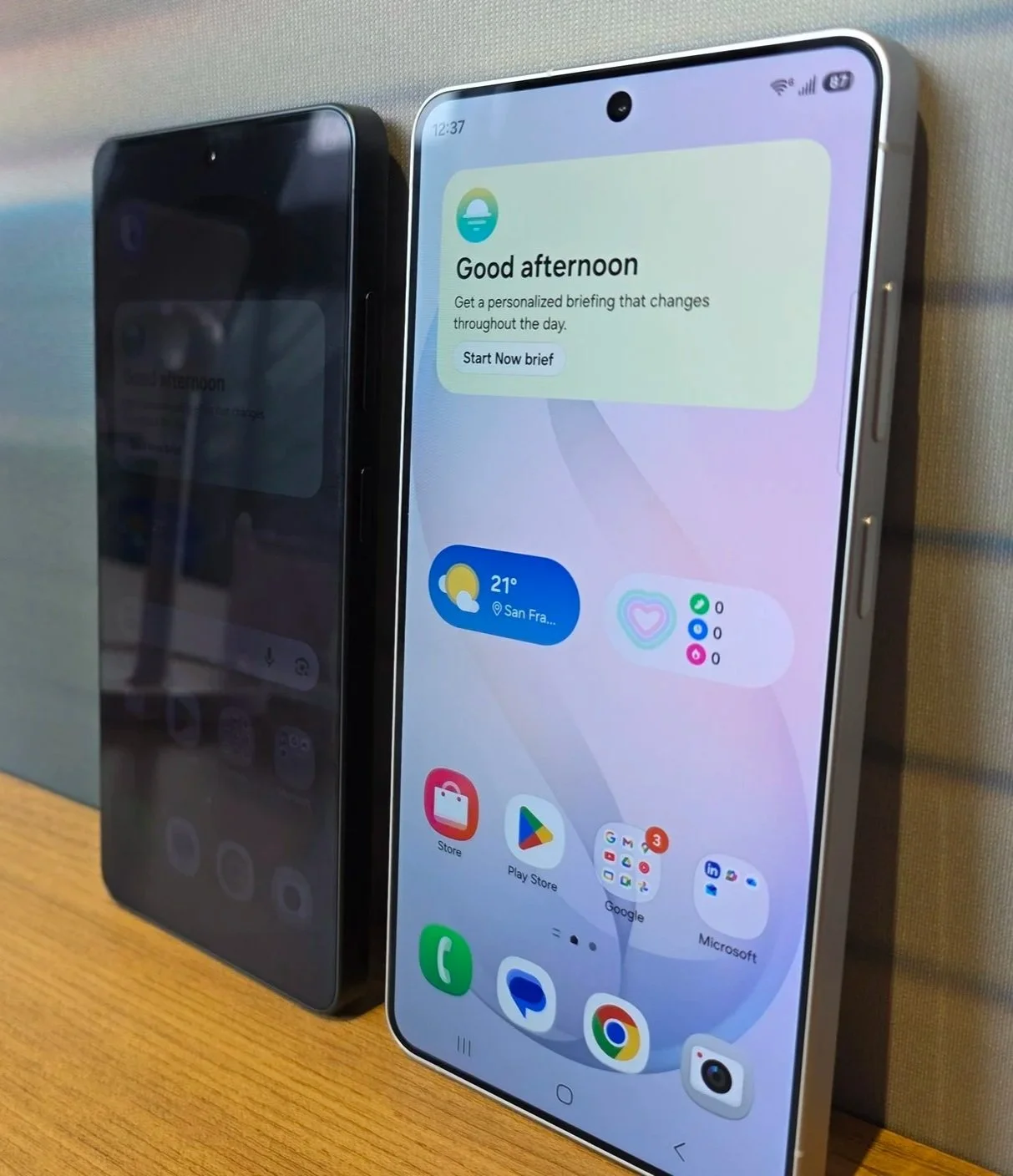
A blizzard kept me from getting to Samsung early enough to take pictures of the actual products in advance. All images in this report courtesy friend of Techsponential Shannon Morse - https://youtube.com/@shannonmorse
We’re at the point in the AI adoption cycle where early adopters have specific model preferences (and often subscriptions) and everyone else just wants a good phone that effortlessly makes them more creative or productive. Fortunately, Samsung is not trying to turn your phone into an LLM prompt machine; most AI features are either working in the background or are integrated into apps. It’s also trying to be more proactive: Now Nudge provides relevant options in whatever you're already doing. Now Brief is supposedly getting better (it wasn’t more than a morning weather widget for me before). Now Bar is set to provide contextual shortcuts and adaptive recommendations. Routine actions, like calling an Uber, are getting an agentic upgrade so the phone can act on its suggestions. We’ll see how this plays out in practice.
Other core apps are getting AI enhancements from Google or Samsung and these are going to be the things that delight mainstream consumers who don’t want to deal with agentic AI or are actively scared by it. Circle to Search is getting better. Call screening is now standard, as is on-device AI for live phishing warnings. Photo Assist can not only remove things from photos, the phone can now add things back in. While there are certain to be the inevitable hilarious fails posted online, I expect this feature will be used a lot; everyone who takes bites out of their food before remembering to take pictures of it can now capture the entire cake for posterity. The Camera app also gets an AI-enhanced document scanner, and Gallery gets screenshot analysis and categorization, which will be enormously useful for people who screenshot receipts, conversations, and photos. Samsung’s incredible AI audio tool, Audio Eraser, now works in YouTube, Netflix, and Instagram.
Hardware Still Matters; Samsung Continues to Iterate
The new Galaxy S26 line looks similar to past versions, but now there is a unified look and corner radius across all three models. The Galaxy S26 Ultra is the slimmest Ultra ever, with armor aluminium (rather than titanium; partly for heat dissipation and partly for cost control) and Corning Gorilla Armor 2 glass for durability. Samsung continues to work towards its sustainability goals, and is now using recycled lithium and tantalum.
Samsung is using Qualcomm’s Snapdragon 8 Elite Gen 5 for Galaxy on all Galaxy S26 Ultra models worldwide. I have been testing the generic version of this SoC on the OnePlus 15 and it is excellent. For Samsung, CPU performance is up 19%, the GPU up 24%, and the NPU is up 39%. The “for Galaxy” part of the Snapdragon 8 Elite Gen 5 is not just binning out faster parts (though it likely is that, too), but also includes a customized application processor for upscaling images. Despite the double digit performance bumps, Qualcomm has also managed to improve efficiency by double digits as well; the physical battery sizes and chemistry have not changed from the Galaxy S25 family, but buyers should expect longer battery life. That huge bump to the NPU will actually be noticeable, too, thanks to Samsung’s extensive AI integration. AI tasks like erasing things in photos now happen twice as quickly. The Galaxy S26 Utra gets an expanded vapor chamber for 20% more heat dissipation for extended performance without throttling; like previous models, the Galaxy S26 Ultra is a stealth gaming phone.
Outside the United States, some Galaxy S26 and S26+ will be getting an updated Samsung Exynos SoC instead of Qualcomm; it too has gotten huge process node and capability upgrades, and Samsung claims it will not be a major downgrade. Tech journalists and YouTubers are sure to follow up on this.
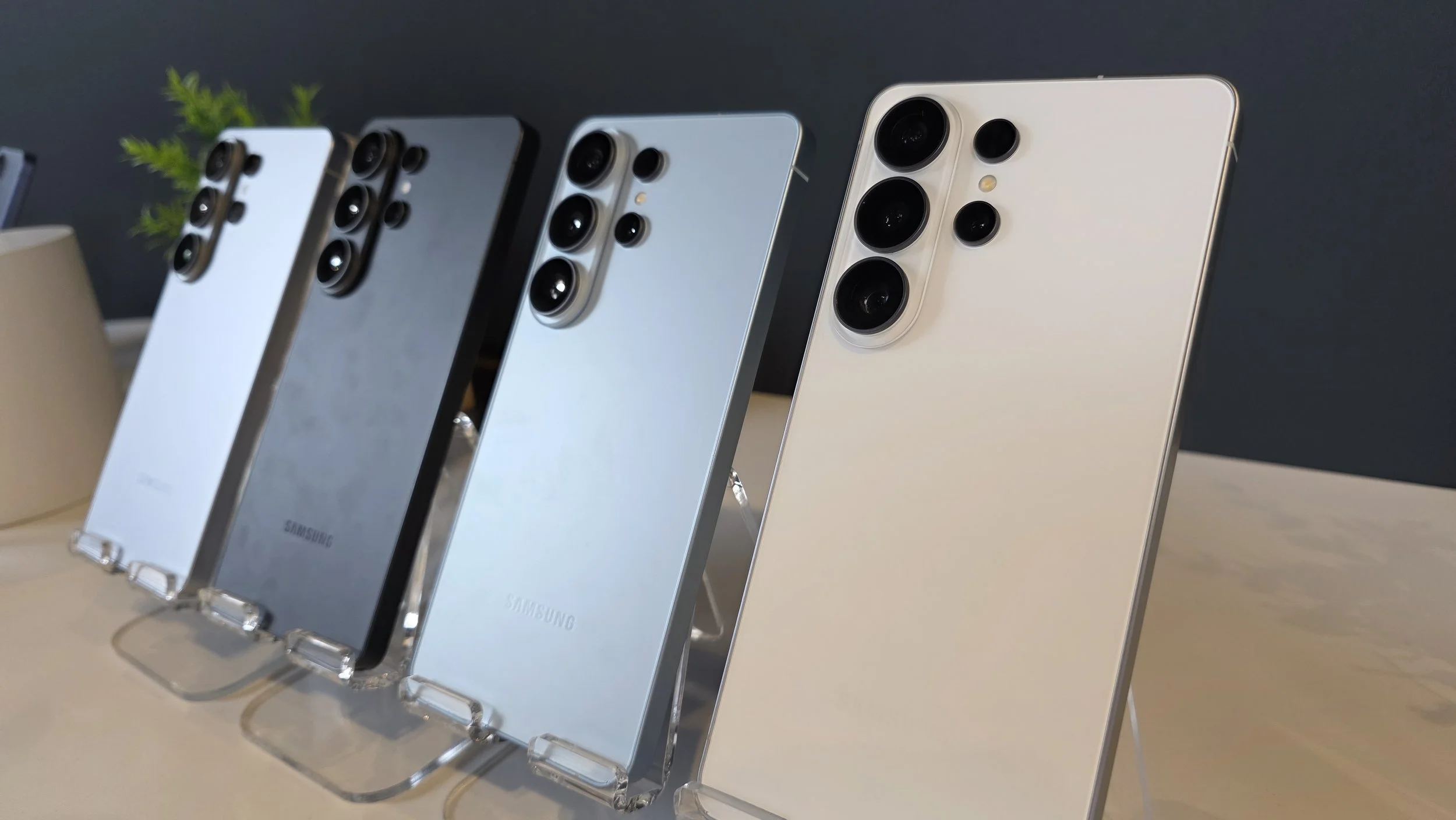
Image courtesy Shannon Morse https://youtube.com/@shannonmorse
The other big component improvement is to the camera. The sensor size is the same but it now lets in 37% more light. That, plus smarter image processing should provide better photos and brighter low light video. The ISP upgrade should improve selfies, too. Samsung has upgraded super steady video with horizontal lock; the changes are obvious in the demos I saw. APV is now available for pro video creation, and you can use the 8K sensor real estate for 4K auto-framing without loss.
Charging improved only slightly in the Galaxy S26 Ultra, and battery technology and capacity stayed the same rather than moving to silicon carbon. Samsung’s battery life gains come from more efficient components, principally the new Snapdragon processor. Silicon carbon batteries offer significantly higher energy density in the same size package – in other words, bigger batteries in the same size phones, or the same size batteries in smaller devices. We have seen companies try both approaches, but most have been Chinese OEMs. For now, the big companies supplying the U.S. carrier market -- Apple, Samsung, Lenovo’s Motorola, and Google – are sticking with older battery chemistry. Their reluctance is partly due to risk aversion – Apple and Samsung both have extremely rigorous safety processes around batteries and chargers – and battery longevity concerns. However, the bigger problem is supply chain logistics: Apple and Samsung collectively manufacture nearly a half billion phones a year, and there just isn’t enough capacity to supply that amount of volume.
Although the Galaxy S26 Ultra now supports 60W charging (up from 45W) and 25W wireless charging, Samsung still remains behind Chinese OEMs on charging speeds. That’s unlikely to hurt Samsung much, but what does sting is that Samsung is not including Qi2 magnets for wireless charging – and Google is on its premium Pixels. You can add magnets in a case, but it would have been a big coup for the volume Android brand to use Qi2 to piggyback on the huge MagSafe accessories ecosystem that Apple built.
…And Innovate
Privacy Display, Samsung’s biggest hardware innovation on the Galaxy S26 Ultra was pre-announced to get ahead of announcements by its component supplier, Samsung Display. Privacy Display provides hardware-level protection to reduce the angle that the display can be read, adjusting each pixel to reduce off-axis viewing (i.e., shoulder surfing). This can be invoked system-wide – and some enterprise buyers may choose to implement this whenever the phone is in Work Profile, but it can also be turned on or off manually, on an app-by-app basis, or even whenever any app asks for sensitive information like passwords. Using Privacy Display when you check your bank balance or whenever you’re working on a plane, bus, or café counter is an obviously good idea. Samsung Display will eventually sell this technology to others, but Samsung’s Galaxy S26 Ultra gets it first.
Schoedinger’s Pricing: Samsung Does/Doesn’t Increase the Price
Pricing on the Galaxy S26 family both did and didn’t increase depending on what you measure. Last year we were worried about ever-changing tariffs. It turned out that Trump’s country-specific tariffs were mostly a non-issue for smartphones even before the Supreme Court ruled them unconstitutional, as the smartphones category received an exemption. We will see if Trump’s latest 150-day 15% blanket tariffs also allow for an exemption, or if they are increased or changed again by the time this report goes live.
What isn’t going to improve over the next 24 – 48 months is the memory shortage. This affects everyone making just about anything that uses memory or storage, though Apple may hold out longer than most because of how far in advance it locks in pricing. Even though Samsung’s chaebol sibling Samsung Semiconductor manufactures memory for Samsung Electronics phones, the inter-company structure does not fully shield the phone business from price increases. Samsung increased the price of the base Galaxy S26 to $900, but it also raised the minimum storage to 256GB. That means the least expensive Galaxy S premium phone is $100 more expensive than before, but it’s only a $40 increase over the Galaxy S25 256GB at launch. The Galaxy S26+ does go up by $100 for the same 256GB configuration to $1100, but the Galaxy S26 Ultra remains $1300 for 256GB, the same as last year. The Galaxy S26 Ultra also gets the Qualcomm SoC in all regions, a bigger vapor chamber, faster charging, and Privacy Display. It has the biggest display, the biggest battery, and still comes with an S-Pen. If that makes consumers gravitate to the Galaxy S26 Ultra as the best value in the line, Samsung is not going to be upset.
It is worth remembering that in the U.S., carrier subsidies can mask price increases. Depending on plans, trade-ins, and new/existing customer status, carriers are offering to cover the entire cost of the phone or effectively make the cost increase feel inconsequential when broken out over a 24 or 36 month interest-free payment period.
Galaxy Buds: Better Than Before, But Falling Farther Behind
Earbuds are an enormously profitable business, especially for vendors who can slot them into an ecosystem alongside phones, tablets, laptops, watches, rings, glasses, etc. Samsung now has two earbud tiers: the Galaxy Buds4, and Galaxy Buds4 Pro. (I remain perplexed why Samsung does not have Galaxy over-the-ear headphones in its lineup.)
The Galaxy Buds4 Pro feature several Galaxy-ecosystem-only integrations such as HD Voice with 16kHz double bandwidth Bluetooth. The Galaxy Buds4 and Buds4 Pro will connect to other Galaxy ecosystem devices straight out of the box with no app download required. They also support Quick Switch multipoint connection only within the Samsung ecosystem.
The Galaxy Buds4 are an open earbud design (i.e., they don’t enter and seal off the ear canal) with an 11mm single driver and modest ANC for $180. For comparison, Apple’s AirPods 4 come in $130 base and $180 ANC versions; both have spatial audio, and Apple’s ANC is surprisingly good. Samsung is matching Apple on the high end pricing without the same level of features.
The $250 Galaxy Buds4 Pro are the bigger upgrade. This is a dual-driver sealed design with ANC 2.0, which only increases noise cancellation by 3db but makes it faster to adapt to your environment. Samsung is focusing on audio quality with the Buds4 Pro, with a wider woofer that increases the area by 20% for enhanced bass, and an improved planar tweeter for crisp treble. There is auto EQ or a 9 band equalizer in the app. The Galaxy Buds4 Pro also get a new, cleaner industrial design that Samsung says provides a more secure fit – it certainly looks nice. The pinch control area is now engraved on the stem and the cradle redesign of the case makes it easier to pick up the Buds4 Pro by the stems.
Other features of the Galaxy Buds4 Pro include real-time translation, optional head tracking, wake by voice, and head gestures: nod to accept calls, shake to decline, and interact with Bixby. Battery life is fine; 6 hours with ANC on, 7 hours ANC off. However, Apple and Bose have set new standards for earbud ANC, and Apple is adding hearing protection, hearing aid, and heart rate tracking to the AirPods Pro 3 that turn them into health devices. We’ll see how the Galaxy Buds4 Pro stack up on audio quality and ANC when I get a review unit.
Did You Know Samsung Makes Laptops?
Samsung’s Galaxy Book laptop series tends to fly under the radar for most consumers and enterprises. This may be in part due to its limited scope: most years Samsung fields just a handful of laptops, distribution is limited, and all of them are in the premium space. (Of course, aside from distribution, Apple also fits this definition.)
Samsung announced three new Galaxy Book6 laptops at CES, and they will be shipping in the U.S. starting March 11. This time around the Galaxy Book6, Book6 Pro, and Book6 Ultra are all powered by Intel Core Ultra Series 3 (Panther Lake) processors. I don’t have review units in from Samsung, but Intel sent a laptop from a competitor that uses the same chip as the Galaxy Book6 Ultra, and it has a much better balance between performance and battery life than past Intel chipsets. Like its phones and earbuds, Samsung is integrating ecosystem-specific features into its laptops; AI Select and Intelligent Search streamline workflows, while Multi Control and Second Screen enable productivity across Galaxy devices.
For Techsponential clients, a report is a springboard to personalized discussions and strategic advice. To discuss the implications of this report on your business, product, or investment strategies, contact Techsponential at avi@techsponential.com.