
Apple Adds Touch, Tandem OLED to MacBook Pro; Competitors Relieved That’s It
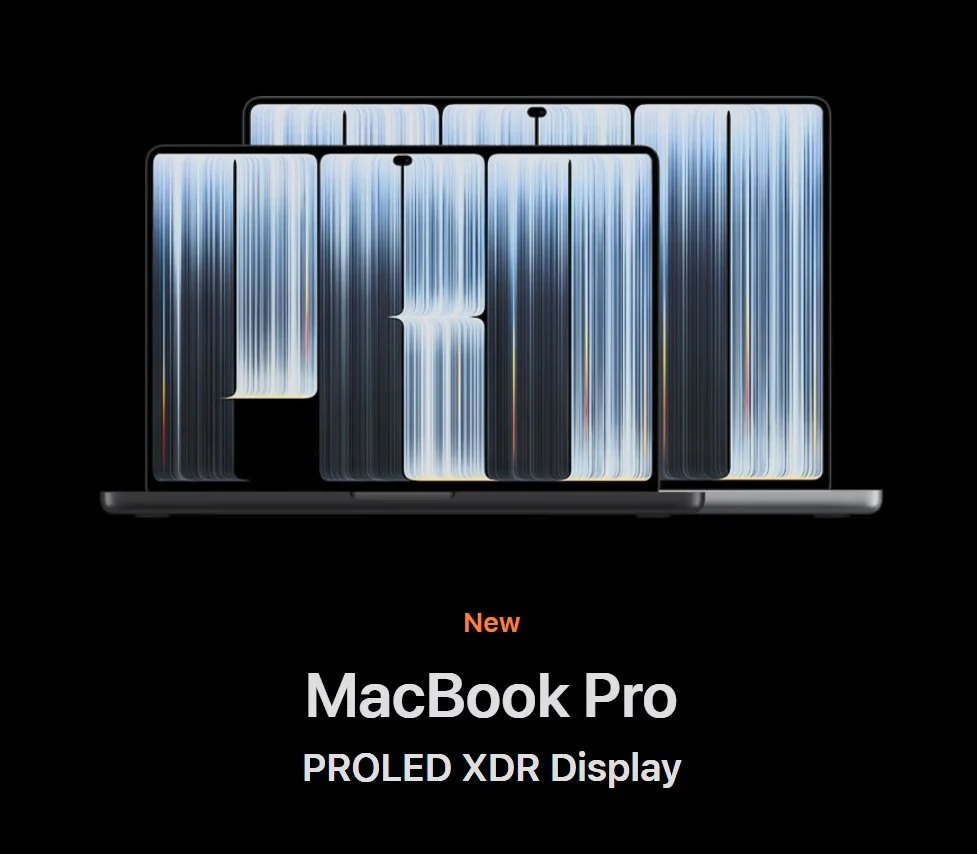
At an LA “Pro and Tell” event, Apple announced a new version of its top-end laptops. The newest MacBook Pro doesn’t get its own sub brand and looks largely the same externally – though the Apple logo on the rear of the display now glows. On the other side of that display, Apple has finally added a touchscreen after spending the last two decades teaching consumers to touch the display on every other Apple product that has one. While most users will use touch on a Mac the same way they do on Windows – for scrolling and occasional selection – Apple showed off creator workflows which use multitouch for music creation and editing, a common interface on iPad Pro apps.
The bigger updates on the MacBook Pro PROLED XDR are to the display and weight. Apple has long used OLED displays on its phones, but not the Mac. With the new model, Apple is jumping all the way to tandem OLED, which doubles up the OLED layers for added brightness at lower power levels. Apple is branding tandem OLED "PROLED XDR," because of course it is, but whatever you call it, it looks stunning. Apple also allows buyers to choose whether they want those inky blacks and bright color saturation to pop even further with a traditional glossy display surface, or to block out reflections with an optional $150 matte nanotexture. This is typically a matter of personal preference, but in offices with harsh lighting or nearby exterior windows, the nanotexture option can be a necessity.
Apple is cutting away less of that display by adding in a Dynamic Island rather than a static notch. This should be almost as useful on a Mac as it is on an iPhone, and the ability to tap the display to expose ongoing task notifications completes the interface element.
The new MacBook Pros are just slightly slimmer than the old models, but weight has come down quite a bit: the 14” is a half-pound lighter (to 3- 3.1 lbs depending on chipset) and the 16” model drops over half a pound to 4 - 4.1 lbs. These are still workstation class laptops, not thin-and-lights, but MacBook Pros are intended to be used on the go. The M5 Pro and M5 Max chipsets are still exceptionally efficient, they should be helped further by the new display, and weight was saved with changes to the thermal management system, not by cutting battery size. There is a $400+ premium for the new display over the miniLED version, but your back will thank you for the lighter weight, even if your wallet objects.
The combination of a lighter weight and stunning display makes this an extremely desirable Mac even if you never notice that the screen can now be manipulated directly. However, this remains a MacBook Pro and will be overkill for regular workflows. Apple will happily sell regular consumers an M5 MacBook Air that fits more typical productivity and web browsing use cases. Apple is widely expected to update the Air to an M6 early next year. For now, you can get the M6 in a base MacBook Pro 14", a Mac mini, or even an iMac. As before, the MacBook Pro PROLED XDR is available with either an M5 Pro or an M5 Max, with unified memory options starting at 24GB and top out at 128GB. Pricing starts at $2900 for 14" and $3400 16" in silver or space black. For creator and productivity use cases, $3600 - $4000 will get you ample power and storage. If you're running local LLMs, expect to spend $7,000+ for max configs; you're essentially paying for tokens up front.
A Competitive Reprieve
As professional laptops go, it’s hard to fault the MacBook Pro PROLED XDR: it adds leading display technology and lower weight to a computer that already had exceptional silicon and great battery life in a chassis that set the industry standard for design and build quality. However, this is relatively good news for the competition which is being reinvigorated by higher performance-per-watt Arm and Arm-adjacent designs from Qualcomm and NVIDIA/MediaTek along with dramatically improved x86 chipsets from Intel and AMD.
Windows laptops have routinely offered touchscreens since Windows 8; on its own this has not been a huge purchase driver for Windows over Mac, so Apple adding a touchscreen to a workstation laptop doesn’t change the competitive dynamic at all. Truthfully, even if Apple puts a touchscreen on every Mac going forward, it likely won’t change which OS consumers pick – it will just make Mac users feel less silly when they reach out to touch the screen and remember that it’s a Mac, not an iPad.
Tandem OLED is wonderful, but it is not free, and while Apple certainly has its own specifications, it doesn’t own the tech – it buys customized panels from LG Display. Dell, Lenovo, and HP each have at least one high-end notebook already on the market with tandem OLED displays. They’ll want to expand that number deeper into their lineups, but they were almost certainly going to do that with or without competition from Apple. When it comes to its higher volume notebooks like the MacBook Air, Apple still hasn’t moved to regular OLED; meanwhile HP just launched the OmniBook 5 with a 2K OLED display at $700 to compete with the MacBook Neo.
Apple’s weight savings may move more customers to upgrade to the MacBook Pro PROLED XDR than the display alone, but, here too, Apple hasn’t pushed the Mac to a place where competitors can’t follow. Some may want to consider shaving some pounds – HP’s OmniBook Ultra 16 with the NVIDIA RTX Spark weighs in at 4.85 lbs.,* a tenth of a pound heavier than the MacBook Pro 16 without the PROLED XDR. However, some Windows manufacturers have already prioritized weight even on 16” performance-oriented laptops; the ASUS ZenBook A16 with Qualcomm’s most powerful Snapdragon X2 Elite Extreme uses ceramized-aluminum (“ceraluminum”) – and a smaller battery than the HP above – to keep weight down to an incredible 2.87 lbs.** That’s less than the new MacBook Pro PROLED XDR 14” model. And battery life on that ASUS is fantastic.
The MacBook Pro PROLED XDR certainly presents strong competition for Windows OEMs, but despite rumors of a radical rethinking of the MacBook, Apple didn’t really change much. The MacBook Pro really does set an industry design standard, and Apple kept that standard largely unchanged. It added a touchscreen, but without any OS software integration that makes it essential to the experience in a way that Windows doesn’t. It dropped some weight, but not too much, and without making any changes to what an Apple notebook looks like or acts like. Most critically, Apple didn’t press its vertical integration advantage the way it had at the entry level with the MacBook Neo. Apple is subject to the same forces that are pushing up component prices for everyone, and Apple still charges an extra premium for adding memory and storage, especially on SSDs. Apple didn’t put the 2nm M6 into its highest volume laptops or even into a base MacBook Pro PROLED XDR. Apple also did not add cellular connectivity, even though the company has its own modem now that it confident enough to use on its $2000 foldable iPhone***. There’s a touchscreen now, but no Apple Pencil support on the screen or the trackpad. In fact, the keyboard and trackpad are completely unchanged. That’s not a bad thing for Apple, but it’s also not a bad thing for Apple’s competitors.
For Techsponential clients, a report is a springboard to personalized discussions and strategic advice. To discuss the implications of this report on your business, product, or investment strategies, contact Techsponential at avi@techsponential.com.
*Part of that weight is due to a hinge design that improves thermal management; I’m seeing better performance on HP’s system compared to other RTX Spark designs from Microsoft and Lenovo. But it is on the larger and heavier end of the scale.
**The non-Extreme version of the ZenBook A16 is actually listed at just 2.65 lbs; I included the version that I have verified.
***As Apple should be. I have noticed no issues with the C2 in my iPhone Duo review unit, currently on AT&T’s network.