
NVIDIA Sparks New Silicon for Windows: Industry Analysis
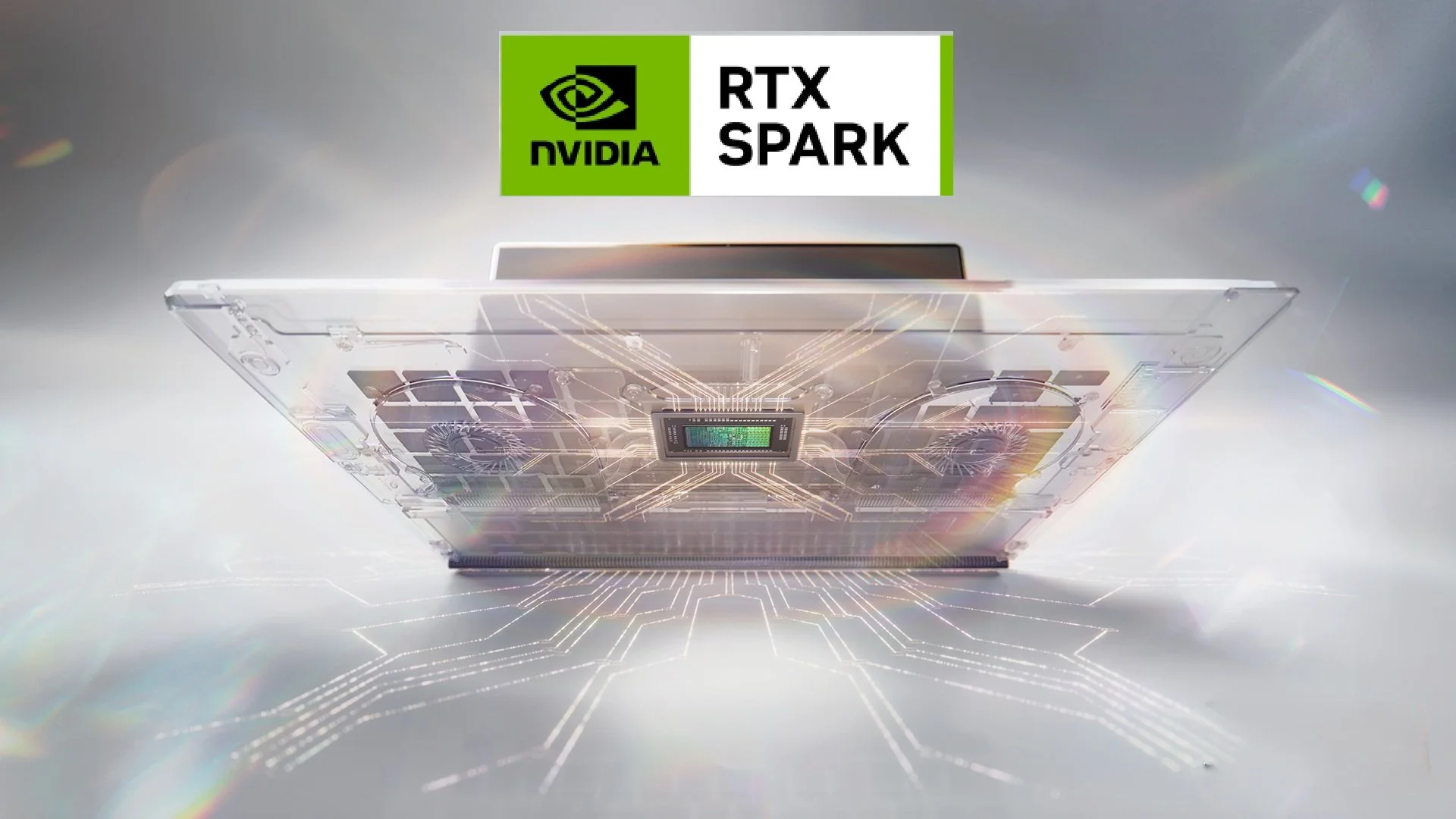
NVIDIA took over Computex with the long-expected announcement of the RTX Spark for Windows. This report covers why NVIDIA is getting back into Windows SoCs and what this means for Microsoft, Qualcomm, MediaTek, PC OEMs, Intel, AMD, and Apple.
Context
NVIDIA is entering the consumer PC market this fall with the RTX Spark, an system-on-chip for Microsoft Windows. The N1x at the heart of the system has up to 20 Arm CPU cores from MediaTek, up to 6144 RTX Blackwell CUDA GPU cores, and up to 128GB of unified memory. This GPU is described as being equivalent to an RTX 5070 and can deliver AI performance topping 1000 TOPS (for comparison, the NPU on Qualcomm’s Snapdragon X2 is listed at 80 TOPS).
This is essentially the same silicon that powers the DGX Spark, NVIDIA’s personal AI workstation. The DGX Spark launched last year with 128GB of RAM at $3,500, and now starts at $4,700. There will be lower-end versions of the RTX Spark coming with an NVIDIA N1; the laptops won’t all start above $5000+. Probably. Battery life on the systems is listed as, “all day.”
NVIDIA has been working on this launch for a while. In addition to getting support from Microsoft on the OS, device drivers, and x86 emulation where needed, NVIDIA has lined up an impressive number of hardware and software partners to build laptops and desktops, and to ensure that RTX Spark systems will be able to run a full array of coding tools, creative apps, and games.
Reactions to RTX Spark have been all over the place: I’ve seen predictions that the RTX Spark will fail outright, or succeed just enough to kill Qualcomm’s PC business, or blow the doors off and put Intel out of business while reversing market share losses to Apple. None of this is right. Let’s dive in.
Why is NVIDIA Doing This?
NVIDIA entering the PC market is not a stretch. It designed chips for Android and Windows in the past, and it’s certainly in a better position to succeed today than it was with its chips for the first Microsoft Surface or its various Shield tablets, TV set top boxes, and handheld game systems. NVIDIA is one of the best capitalized silicon design companies in the world thanks to its leading position in AI data center buildouts. However, from a short-term financial perspective, NVIDIA building PC chips is a terrible idea. It would lose money with every wafer it dedicated to an N1x for an RTX Spark rather than a GB300 for a datacenter. That’s one of several reasons that MediaTek is a core partner. In its press release MediaTek states it is, “Leveraging its low-power expertise and strategic manufacturing partnership with TSMC.” In other words, MediaTek is likely using its own TSMC capacity allocation. (This partnership is a huge win for MediaTek for its own strategic reasons – see below.)
The reason NVIDIA is launching RTX Spark is not to steal market share from Intel or even Apple, but to ensure that its architecture is used for AI development over the long term. Last year’s DGX Spark is essentially a purpose-built coding and research platform, which is only relevant to serious development shops who are choosing CUDA. In contrast, an Apple MacBook Pro can be used to write AI code for various architectures and also serve your entire personal computing needs (other than full AAA gaming). NVIDIA is not positioning the RTX Spark exclusively as an AI development platform – it pointedly showed off gaming and video editing in its demos – but it is spinning a vision of it powering AI-centric operating systems and local, $0 token workflows its silicon performance enables.
The RTX Spark is an Arm-based system targeting Windows power users, so NVIDIA is relying heavily on Microsoft to make some of those AI-native operating system features, but also to give the system a marketing push to developers, OEMs, and consumers. Windows on Arm has come a long, long way. Most common apps have been recompiled for Arm, and Microsoft’s Prism translation layer takes care of most other commercial apps. I have been using Qualcomm’s top Snapdragon X2 Elite Extreme in the ASUS Zenbook A16 and it absolutely screams. My entire workflow is native. I also haven’t run into any peripherals that won’t work with it, including obscure scanners and no-name optical drives. There are still x86 AAA games that need conversions, a few heavy-duty creative apps that don’t run well in emulation, and internal corporate apps that haven’t been updated. Microsoft and Qualcomm were making steady progress on the former category, but the addition of NVIDIA – and its rich relationship with developers thanks to its discrete graphics cards and chips – is giving new incentives for the holdouts to make the investment in getting their apps to run natively. Qualcomm’s Oryon CPU and Hexagon NPU offer astonishing performance per watt, but the Adreno GPU hasn’t always been class-leading, and Qualcomm hasn’t offered discrete GPU alternatives. NVIDIA is promising discrete RTX5070-like GPU performance in an integrated package with unified memory on the RTX Spark, and that should make developers and gamers pay attention.
Corporate developers are a separate category; if IT has standardized on x86 and is satisfied with Intel and AMD options, supporting two code bases is a tough sell. Qualcomm was hoping that its large and efficient NPUs would drive local AI workflows, but that hasn’t happened yet, and NVIDIA is promising much the same idea via the GPU. We’ll have to see if the software and usage models change for that to be a purchase factor.
None of this means that RTX Spark will be a strong seller. To start, NVIDIA is targeting the most expensive, lowest volume segment of the market during a component pricing spike that is expected to last for at least the next two years. The competition in this segment is strong: Apple Silicon is extremely powerful, and the Mac line is tied into its own software and services ecosystem. Qualcomm’s newest chips have seen huge percentage improvements generation over generation. Intel and AMD CPUs are also competitive when paired with enough RAM and GPU horsepower: I’m testing an Intel-based Lenovo Thinkpad P16 laptop with its own NVIDIA RTX PRO Blackwell 5000 GPU that benchmarks like an RTX 4000-series gaming desktop. But NVIDIA doesn’t need to sell millions of RTX Spark systems to succeed, it just needs to get a critical mass of developers to use its architecture and tools. If, in the process, RTX Spark dent MacBook Pro sales even a little, that will make Microsoft extremely happy.
RTX Spark Beneficiaries: Microsoft, MediaTek, and …Qualcomm?
The biggest beneficiaries of RTX Spark are NVIDIA’s partners, Microsoft and MediaTek, and, ironically, its rival Qualcomm.
Microsoft has been pushing Windows on Arm because Apple Silicon was giving the Mac performance and battery life that Intel could not match. The latest Intel Core Ultra Series 3 (“Panther Lake”) chips are marked improvements, but the threat of direct competition from Qualcomm was a factor in that. NVIDIA fills out the Windows on Arm ecosystem at the high end.
MediaTek has been moving upmarket in the computing market, from inexpensive chips for Android tablets to inexpensive chips for Chromebooks to genuinely performant Kompanio SoCs for premium Chromebooks. It is one of three silicon companies vying for Googlebook orders – expected to compete with the MacBook Air and similarly priced premium Windows laptops. MediaTek is also NVIDIA’s partner for the GB10 in the DGX Spark mini desktop, and now the RTX Spark laptops and desktops. The new initiative fills out MediaTek’s computing portfolio to the upper end of the personal computing market without taking on much risk or expense. Qualcomm got there first, the hard way by investing time and money into market-making to help its Snapdragon PC platform break into Windows against Intel and AMD. Beyond the cost of R&D, Qualcomm has had to convince OEMs to try a different microarchitecture, work with Microsoft to convince developers to recompile or rewrite their apps, work with distributors and retailers to support an alternative to x86, and build a brand and educate consumers and enterprises to consider a switch. MediaTek gets to piggyback on Qualcomm’s efforts, and NVIDIA’s top-of-the-NASDAQ brand gets its processors the OEM support and retail shelf space. In exchange, MediaTek gives up top billing (and some margin) to NVIDIA, but MediaTek has long been OK operating partly behind the scenes.
Qualcomm has been doggedly investing in building Windows on Arm for years. When it first launched Windows on the Snapdragon 835 at Snapdragon Summit back in 2018 it promised always-on connectivity in the background and week-long battery life. The company had to walk back those claims – it wasn’t even remotely realistic. Even basic performance for Office apps – which Microsoft had not recompiled for Arm – was incredibly pokey. Microsoft slowly improved the software and Qualcomm kept at it with the Snapdragon 850 and 8cx, 7c, and 8cx. In 2021 Qualcomm bought Nuvia, founded by former Apple Silicon engineers, and repurposed its datacenter silicon CPU architecture for laptops in the Snapdragon X in 2024, and the Snapdragon X2 last year. Concurrently, Qualcomm has doggedly pursued OEM design wins, retail placement, and spent big on marketing.
Snapdragon had an exclusivity period as the launch partner of Microsoft’s Copilot+ PC initiative, which Qualcomm had hoped would captivate consumers and drive sales. It …didn’t. However, Snapdragon has served as the best option for PC OEMs trying to compete with Apple on performance-per-watt, offering long battery life and excellent performance even when away from a power outlet. NVIDIA entering the market is more likely to grow Windows on Arm overall than steal sales from Qualcomm. Its brand and clout with software developers – along with broad support from OEMs including Microsoft itself – validate the architecture and mitigate concerns with app compatibility. However, when consumers and IT managers go to actually buy something, unless they really are looking for a super-premium option, Qualcomm-based systems are going to be a lot more affordable and realistic.
Crucially, Qualcomm built out a broad Snapdragon X product line across a wide range of price points, with Snapdragon X Elite Extreme, Elite, Plus, and base models. That price range just got even wider with the Snapdragon C also announced at Computex, which Qualcomm claims is aimed at giving extremely low cost laptops reasonable performance and long battery life. The RTX Spark competes against the MacBook Pro; Snapdragon C gives Windows a way to counter the MacBook Neo*. Qualcomm still needs to close the GPU gap and maintain OEM attention in an increasingly chaotic market, but, at least in the short and medium term, competition at the high end from NVIDIA will help a lot more than hurt.
Windows OEMs: Pros and Cons
Microsoft is the least conflicted laptop OEM because the Surface line isn’t aimed strictly at selling the most unit volumes, but at setting a hardware standard for Windows. Microsoft has a deliberately small Surface product line, and it can afford to spend the resources to support multiple Arm-based silicon suppliers. Microsoft is therefore aiming high with the Surface Laptop Ultra, which should have the top N1x silicon and RAM specs alongside a bright 15” mini-LED touchscreen with 262 PPI resolution. It has the largest haptic trackpad of any Surface, one of the larger batteries, and an all-new thermal management system. It is 18mm thick and weighs 4.5 lbs.; Microsoft is optimizing for performance and battery life while retaining portability. Although it is not expected to ship for months, Microsoft has been demoing the Surface Laptop Ultra running heavy engineering, productivity, and gaming workloads at Computex.
For everyone else, it’s more complicated. These are not going to be high volume sellers for individual OEMs, yet they will require a lot of engineering, marketing, and support work. This is coming at a time with Google has its own AI-centric laptop platform coming, Googlebook, that OEMs have all gotten behind. Resources are going to be strained once the supply of RAM that the largest vendors have secured runs out.
At the same time, NVIDIA is also a strategically important supplier of discrete GPUs for the rest of their premium and gaming systems. They won’t want to disappoint NVIDIA and get shut out of those allocations. And they really have been looking for a way to better compete with Apple Silicon, and while the Snapdragon X has been competitive in performance-per-watt, they are eager for a silver bullet.
Intel and AMD Get New Competition
Another Arm competitor is not good for Intel, especially in its highest margin segment. However, NVIDIA won’t touch Intel’s sales volumes overall, and it won’t impact foundry at all – NVIDIA/MediaTek could even be another potential foundry customer (in the distant future. If ever.) Intel and AMD also have incumbent advantages: some companies are standardized on x86 and there are no compatibility issues to work around for legacy corporate apps. Finally, while it won’t offer good battery life, you can always pair a discrete NVIDIA GPU with an Intel CPU today.
Neither company offers anything competitive with the RTX Spark’s N1x today in terms of system TOPS, but both Intel and AMD also have their own GPU expertise with Arc and Radeon RX, respectively. Intel has been making significant strides getting driver support from software vendors, and although it has aimed at the value segment for add-on cards, the graphics IP is there should it want to scale up. For basic gaming and engineering workloads, Intel already provides a robust integrated GPU with the integrated B390 GPU in higher end variants of Intel’s latest Core Series 3 Ultra.
AMD has its own laptop-oriented AI chipset, the Ryzen AI 9 HX Pro 400 series (aka, “Gorgon Halo”). I tested the 300 series chip (aka, “Strix Halo”) last year on the HP G1a and found that – when plugged into power – it performed well across the board. AMD is specifically touting its ability to use up to 128GB of RAM, of which 96GB can be allocated to VRAM for the GPU, and then achieve record time-to-token results on Llama. For now, NVIDIA is not providing any real-world benchmarks for Windows, so like-to-like comparisons are impossible. Even if NVIDIA does push Intel and AMD to rethink what’s needed at the top of their lineups, until it is able to target other parts of the price curve, neither company is in imminent danger. AMD seems content to focus on the midrange and higher, but, like Qualcomm, Intel is also concerned about volume sales and providing the Windows ecosystem with a way to compete against the MacBook Neo. For Intel, that’s a stripped-down version of Core Series 3 (aka, “wildcat lake,”).*
Apple is Doomed. DOOOOMED!
RTX Spark is targeting Apple’s MacBook Pro and Mac Mini. Competition for agentic AI systems from NVIDIA isn’t good for Cupertino – who wouldn’t want to have a minor product line like the Mac Mini turn into a spectacular hit out of nowhere? However, RTX Spark is not a strategic threat to Apple’s business model – Apple doesn’t sell its silicon independently, and even the Mac’s premium hardware is usually purchased to access Apple’s software and ecosystem experience.
Apple will have its chance to respond – first with its own concept of how AI will be integrated into its OS this week at WWDC, and then later in the year with its own hardware announcements. Apple has a lot to prove on the software front. However, it has already proven that Apple Silicon scales remarkably well, and Apple can always lean on its software differentiation – not just for ecosystem lock-in, but performance as well. I’m testing a MacBook Pro M5 Max with 128GB of unified memory, and its GPU performance is impressive on generic Open CL benchmarks but jumps by 50% when you use Apple-specific Metal. Vastly more powerful Windows laptops could slow Apple’s market share gains, but Apple will be fine.
*It remains to be seen whether OEMs can build a compelling product below $500 with any processor. The MacBook Neo is disruptive not just because it uses an inexpensive SoC: its build quality and components are much nicer than the competition. MacOS also runs better on 8GB of RAM than Windows does, though I haven’t gotten any the new Wildcat Lake or Snapdragon C systems in yet to see if the new silicon changes the experience.
For Techsponential clients, a report is a springboard to personalized discussions and strategic advice. To discuss the implications of this report on your business, product, or investment strategies, contact Techsponential at avi@techsponential.com.